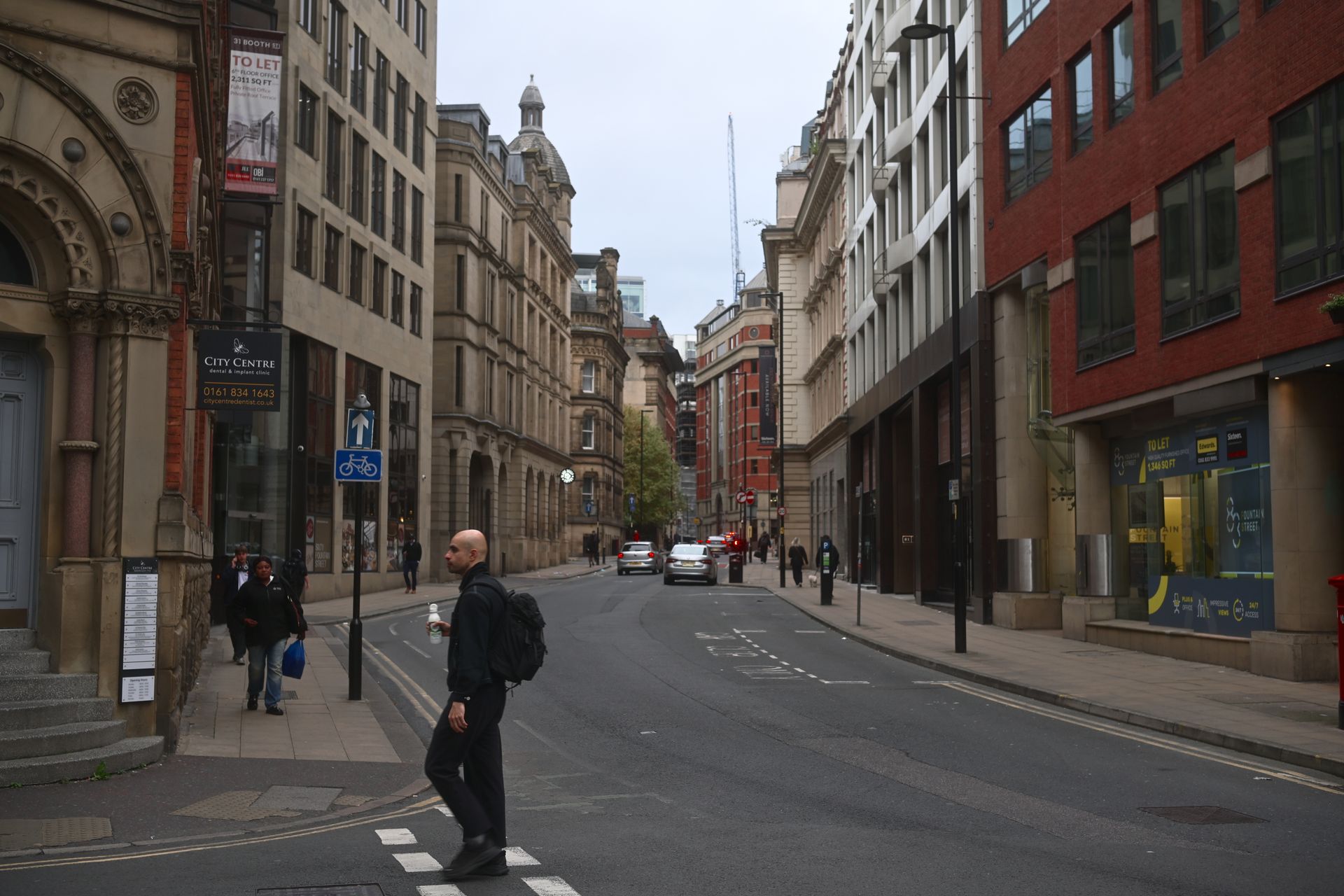
Greater Manchester is not a single search market. It is ten districts, each with its own commercial identity and its own set of local search results. The city centre draws professional services, hospitality, and retail. Salford has become synonymous with media and digital since MediaCityUK opened in 2011, now housing the BBC, ITV, and hundreds of production companies and tech startups. Trafford Park remains one of Europe's largest industrial estates. Bolton, Bury, Rochdale, and Wigan each serve their own catchment. A local SEO strategy that targets 'Manchester' as a single keyword misses how people actually search — they search for services in their district, their town, their postcode.
Manchester's tech sector has grown faster than any UK city outside London over the past decade. Manchester Digital reports more than 10,000 digital and tech companies across the region, employing over 100,000 people. This means the businesses competing for local visibility online are often digitally literate and already investing in their web presence. Standing still is not an option. If your competitors are running structured keyword research and publishing area-specific content, they will outrank you month after month. The businesses that track their rankings and respond to changes are the ones that hold their positions.
The Local Pack — the map-and-three-listings block at the top of Google — dominates local search in Manchester just as it does everywhere in the UK. Over 80% of local searches never result in a click to any website. Your Google Business Profile is effectively your shop window for the majority of people who find you. Review count, response time, photo quality, category accuracy, and posting frequency all feed into where you appear. A well-built website with a neglected GBP is invisible to most local searchers. Manchester consumers are particularly review-driven — the city has one of the highest review-per-business ratios outside London.
Manchester's postcode system creates natural search boundaries. M1 covers the city centre. M3 covers Salford and the Irwell corridor. M20 and M21 cover Didsbury and Chorlton, two of the most commercially active suburbs in the south. A business registered in M4 (the Northern Quarter) will not automatically rank for searches made in M33 (Sale) or M60 (the old postal district for central offices). Expanding your visible footprint requires area-specific content pages, consistent NAP citations across local directories, and a Google Business Profile service area that matches where you genuinely operate.
Agency fees in Manchester typically run from £800 to £3,000 per month — lower than London but still beyond reach for most independent businesses and sole traders. A plumber in Stockport or a restaurant in the Northern Quarter needs the same quality keyword data and ranking intelligence as a large corporate, but cannot justify an agency retainer. RnkRocket provides weekly rank tracking, an AI-powered site audit, content recommendations tailored to your area, and competitor analysis — all for £9.95 per month. Professional-grade local SEO tools at a price point that works for the businesses that actually need them.